Showing posts with label processing. Show all posts

Sunday, December 19, 2021

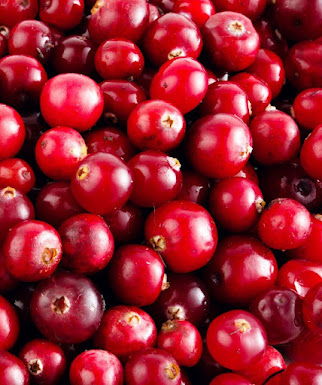
Cranberries post-harvest

The fruit are harvested at full maturity with good color (anthocyanin content) but prior to the fruit becoming over-ripe. Timing of harvest is important for fresh-market fruit so that the berries are sufficiently red but retain good storage quality.

The onset of color is associated with a distinct rise in ethylene production by the fruit. Fruit should have intense red color, surface shine, uniform size, good firmness, and freedom from defects.

At the processing plant, cranberries were sorted by visual inspection into four ripeness stages: dark-red, light-red, blush, and white. Fruit showing rot, mechanical injury, disease, or flesh softness were discarded.

Cranberries are cleaned in fanning mills, then dropped some distance to eliminate soft or rotten specimens (the defective berries do not bounce, those suitable for food bounce up over a barrier), then washed, first in acid or alkaline solutions to remove spray residues, then in water.

Cranberries handled as fresh are packed in paper fined wooden boxes, and the product is slowly cooled to 36 – 40 °F. The use of refrigeration and proper temperature control is the primary postharvest technology used to extend the storage life of fresh fruits.

Many factors can affect chilling sensitivity and the expression of damage to the fruit. These factors include growing conditions, cultural practices, and fruit maturity. In addition, the expression of physiological breakdown is dependent on storage duration. Cranberries should be held at 36 - 40 °F until sold to the consumer.

At this temperature, cranberries have a storage life of several months. Cranberries may be held frozen prior to the manufacture of jelly or sauce. They are placed in large metal containers, frozen, in bulk in cold-air rooms, and held in this condition until defrosted for purposes of preparing cooked products.
Cranberries post-harvest
Sunday, January 31, 2021

Instant noodles: Classification and processing

Noodles are long thin piece of food made from a mixture of flour, water and eggs usually cooked in soup or boiling water. An instant noodle is a food item made from unleavened dough that is made from different types of ingredients.

According to Codex definition, instant Noodle is a product prepared from wheat flour and/or rice flour and/or other flours and/or starches as the main ingredient, with or without the addition of other ingredients. It may be treated by alkaline agents. It is characterized by the use of pre-gelatinization process and dehydration either by frying or by other methods.

Instant noodles appeared to have originated in Japan in the 1950s and today, are consumed in more than 80 countries, become internationally recognized food. Noodle industry supplies 95.4 billion servings annually to consumers throughout the world, and the demands are on the rise.

Instant noodles are made from wheat flour, starch, water, salt or kan sui (an alkaline salt mixture of sodium carbonate, potassium carbonate, and sodium phosphate), and other ingredients that improve the texture and flavor of noodles.

The properties of instant noodles like taste, nutrition, convenience, safety, longer shelf-life, and reasonable price have made them popular. Quality factors important for instant noodles are color, flavor, and texture, cooking quality, rehydration rates during final preparation, and the presence or absence of rancid taste after extended storage. Instant noodles can then help in shortening preparation times and produce good quality results, while maintaining nutritional values.

Instant noodles are classified into two types on the basis of methods used for the removal of moisture, i.e., instant dried noodles and instant fried noodles.

Instant dried noodles are produced in a fully automatic production line similar to the type used for steamed and deep-fried noodles, except that a continuous drying chamber replaces the deep fryer, using hot air as the drying medium.

Frying the noodles in oil at 140-160 ºC for 1-2 minutes decreases the moisture content of noodles to about 2–5%, whereas in hot air-dried noodles, it is about 8–12%.

While any edible oil is suitable for frying, palm oil or palm olein is often used in Asia and mixtures of canola, cottonseed, and palm oils are commonly used in North America. The process leads to shrinkage and raises the level of porosity and roughness. The moisture contained in the gelatinized starch granules evaporates due to the high temperature. The empty spaces previously occupied by the moisture are next partially filled with oil

In hot air drying, the noodles are held at 70-90 ºC for 30-40 minutes to achieve an 8-12% moisture content.

The heating during frying or hot air drying further gelatinizes the starch and the noodles attain a porous texture, which facilitates rehydration process while cooking the product.

Instant noodles are commercially available in two packaged forms - in a cup with the seasoning sprinkled over the noodles or in a pouch (or bag) with the seasoning provided in a sachet inside the pouch.
Instant noodles: Classification and processing


Saturday, February 24, 2018

Decaffeination of tea by ethyl acetate processing

To be considered truly decaffeinated for labeling purpose, tea must contain no more than 0.4 percent of caffeine by dry weight.

The most common decaffeinating solvent is ethyl acetate, a substance that occurs naturally in some fruits and non-toxic component of tea. The ethyl acetate decaffeination process uses the Haco Method, which is similar to the one used for coffee. Chemically, ethyl acetate breaks down into ethanol and acetic acid.

In this process, tea leaves are bathed in water washed with ethyl acetate to remove the caffeine and then dried.

This process leaves a maximum carrier residue of 1 ppm or less, and a maximum caffeine residue of 0.08 percent, dry weight. The tea is 99.9 percent decaffeinated at the end of the process, and has an 8 percent maximum water content when leaving the factory. Decaffeinated Ceylon Black is processed in this manner.

However, ethyl acetate is very difficult to remove after the decaffeination process and can leave a chemical taste.
Decaffeination of tea by ethyl acetate processing

Saturday, May 9, 2015

Canned Blueberries

Fresh ripe blueberries may spoil of left out at room temperature for a day or more, but they will keep for 2 or 3 days if stored without washing in a covered container in the refrigerator. Canned blueberries can be light or heavy syrup packed or water packed.

Blueberries can be canned, mostly used for pie fillings, are cleaned and inspected, placed in cans, and the cans are then filled with water or with a 10-30% sugar solution to cover the head space.

The open cans are the exhausted or heated in free-flowing steam for 10 minutes, and finally sealed and heat process at about 93-95 °C with 25-30 minutes holding time.

The packing syrup from canned or frozen berries usually has picked up much of the color and flavor form the fruit. Hence, it may be used as a flavoring or a syrup for ice-cream sodas and sundaes, milk shake, mixed drinks, pancakes and waffles.

Compared with other fruits, canned blueberries are an excellent source of iron, fair sources of vitamin A, about average in protein fat and calcium and low in phosphorus.

Canned blueberries packed in water are low in calories and carbohydrates because they contain only about two-thirds the levels of the nutrients that are supplied by the raw fruit.
Canned Blueberries

Saturday, April 4, 2015

Decaffeinated tea

In General Tea from the Camellia Sinensis family contains from 1.6 percent caffeine in Formosa broken leaf type to 4 to 4.5 percent in most other types. By U.S. Food & Drug Administration standards, 97 percent of the 4.5 percent caffeine must be removed in order to label the tea decaffeinated.

Some packers label their teas 98 percent caffeine free. These teas, however, have never been decaffeinated but have a naturally low caffeine count.

Decaffeinated tea leaves unfortunately produce a flatter-tasting tea. Decaf tea also lacks the ‘aliveness’ and intensity of regularly processed tea.

Tea is decaffeinated by various methods. There are three processes used to decaffeinate tea: methylene chloride, ethyl acetate and carbon dioxide.

The latter two are the only two permitted in the United States. The use of methylene chloride on tea uses the same processing methods as ethyl acetate (see below) but is not allowed for import to the United States.

The most common decaffeinating solvent is ethyl acetate. Chemically, ethyl acetate breaks down into alcohol and acetic acid. Both these components are considered safe for use in decaffeinating by the FDA.

Carbon dioxide is a high pressure, super critical process. Unlike the other two processes mentioned, this process is considered natural and is more gentle to the tea leaves. It has the added advantage of retaining 90 percent of its polyphenols, the healthful antioxidants abundant in green tea.

The decaffeination technology affects the constituents drastically in case of ethyl acetate because besides caffeine most of the catechins and certain related compounds are also removed. Tea decaffeinated using ethyl acetate loses up to two thirds of its flavonoid content.
Decaffeinated tea 

Thursday, June 19, 2014

Processing of pasta

Pasta manufacturers today produce many varieties of dried products with hundreds of shapes and sizes available. These products may be broadly classified as either short or long goods.

Pastas are generally made of flour and water although eggs are sometimes added. Durum semolina is the best material for making flour for pasta.

Durum wheat is hard wheat and gives pasta its yellow color and is generally different from common wheat. Dough made from it requires less water than flours, and pasta dough contain only about 25% water compared to about 40% in bread dough.

In order to produce superior quality, attention has to be paid to the source and quality of raw materials used; the quality of water mixed with the raw materials to form dough prior to extrusion; the quality of other ingredients used in the dough mix; extrusion condition; and drying conditions.

In pasta making, after the dough is made it is extruded into various shapes. A single screw extruder with deep flight channels to eliminate shear is used for the extrusion of pasta products.

It acts as a mixer, kneads the dough and exerts pressure. The dough then is dried to about 12.5% moisture. This process is sensitive and requires much care to assure the timing and temperatures are perfect to dry thoroughly but not too quickly.

Drying is most important process in pasta production as cracking or checking can occur if the product is not dried properly.

After the final drying, there is a cooling. Cooling conditions must be carefully controlled to avoid the checking that can arise if there is a moisture imbalance with the pasta.
Processing of pasta


Tuesday, February 25, 2014

Food irradiation

Radiation meaning emission and propagation of energy though space or through a material medium in the form of waves: for instance the mission of electromagnetic waves, or sound and elastic waves.

Food irradiation is the use of ionizing radiation to increase food storage life, reduce postharvest food losses and eliminate food poisoning micro-organism.

Decades of research have conclusively shown that food irradiation can have myriad beneficial applications, including for example, the disinfestation of insects in fruits and grains, the inhibition of sprouting in potatoes and onions, the delayed ripening of fresh fruits and vegetables and the enhanced safety and sterilization of fresh and frozen meat products, seafood and eggs.

Particle of ionizing radiation have the ability to penetrate into the depth of a food.

Through physical effects they interact with the atoms and molecules that make up the food and also those of food contaminants such as bacteria, molds, yeasts, parasites and insects, causing chemical and biological consequences which can be utilized in beneficial ways.

The process is responsible for nutritional changes in an irradiated food. This describes nutritional changes due to radiation processing, which depend on the composition of the treated food and the amount of absorbed dose.
Food irradiation

Saturday, December 1, 2012

Processing of Apples

Sliced apples have multiple uses and are preserved by many different methods such as canned, refrigerated, frozen or dehydrated states.

Apple slices 
A number of different techniques are used to maintain flesh color, flavor, and crisp texture of apple slices. Apples are size graded peeled, cored, sliced and immersed in a 3% salt solution.

Just before filling into cans, the slices are rinsed to remove salt. They are then filled into can with 40% sugar solution, the cans are then heat-exhausted, sealed and heat processed.

The canned apples are either at 82,2° C and immediately to 32-40 °C.

Frozen apple slices 
For the production of frozen apple slices, the slices are immersed in brine subjected to vacuum (in order to remove air), re-immersed in brine, washed and packed with sugar in a ratio of 4 fruit to 1 sugar, the product is then frozen.

One method differs in that a bisulfite dip is included to prevent non enzymatic browning. It done after inspection. The alternatives to sulfite are based on ascorbic acid, citric acid and calcium salts.

Nitrogen and carbon dioxide (CO2) are the most popular freezing media. From vacuum tank, the apple slices pass though and IQF unit, whether the slices are individually frozen.

Dried apple 
Drying as a method of food preservation has been practiced since the earliest recorded history. The best quality are obtained from ‘Red Delicious’ and ‘Golden Delicious’ apples.

Some apples are dried, although the volume of this type of product has decreased in recent years. For drying, the peeled, cored and sliced apples are first treated in a weak solution of citric and a bisulfite dip.

Up to 300 ppm of bisulfite are used to prevent enzymatic browning. The sulfured slices should be held in refrigerated storage for at least 24 hrs to allow the sulfur dioxide to penetrate the apple slices, the apple slices are eventually spread in the slatted floors of natural draft, loft-type kilns.

In the kilns, heated air rises through the apples slice and removes moisture. After the moisture content has reached about 10%, the apples are packaged in moisture proof containers to be used in the bakery trade. 

Consumers like the dried apples to be as possible in eating quality to a fresh apple, thus the texture, color, and taste of dried apple are important.
Processing of Apples

Wednesday, October 31, 2012

Microwave in food processing

Microwave heating takes place due to the polarization effect of electromagnetic radiation at frequencies between 300 MHz and 300 GHz.

There is not much commercial use of these frequencies for food pasteurization or sterilization, although they are used in baking and other processes in the food industry.

The use of microwave for food processing is continuously developing world-wide. Faster heating and high energy efficiency are the major advantages of microwave processing of food.

Food shape, volume, surface area and composition are critical factors in microwave heating, These factors can affect in microwave heating.

Microwave energy, like all electromagnetic radiation, travels in a wave pattern. The waves are reflected by metals; pass through air, glass, paper, and plastic; and are absorbed by food. Most microwave containers are designed to transmit microwave energy without reflecting or absorbing it, and thus are made of paper or plastic.

Microwave heating has also found applications in the food industry including tempering of frozen foods for further processing, pre-cooking of bacon for institutional use, and final drying of pasta products.
Microwave in food processing

Saturday, October 22, 2011

Processing of fruit

Fruit processing may be started on 4000 BC. At that time the Egyptians already master viticulture and the art of wine making.

Oranges, apples, grapes and bananas are the most popular fruits. The consumption of fruits and processed products has enjoyed an unprecedented growth during the past decade.

Most juices are derived from fleshy fruits and these may be conveniently subdivided for processing into three categories.
• Fruits which are pulped and their juices removed by pressing e.g., apple, berry fruits
• Fruits requiring the use of specialized extraction equipment, e.g., citrus fruits, pineapples
• Fruits requiring heat treatment before processing, e.g., tomatoes, stone fruits

In most large fruit processing operations the plant is usually dedicated to one type of fruit. By far the largest volume of processed apples and oranges, the two most important fruits commodities, is in the form of juices.

The aim of the juice extraction process is to obtain as much juice out of the fruit as possible while preventing rag, oil. and other component of the fruit entering the juice.

Citrus fruits are unusual because the outer skin or flavedo is rich in essential oils and other tissues such as the albedo or carpellary membranes contain substances that give rise to bitter flavors.

The processing of citrus typically involves separation of these various components as an important principle and for certain products such as comminuted bases, the various components are recombined in different proportions.

The stone fruits are characterized by a fleshy mesocarp (pulp) surrounding a wood like endocarp or stone, referred to a in agriculture and processing circles as the pit.

The flesh of stone fruits is separated from the stones or pits, not only to facilitate ease of handling, but also because the stones are further processed to obtain both fixed oils and glycosides.

Fixed oils, such as those from peach, have application in the cosmetics industry and glycosides may be used as a source of other natural flavoring ingredients such as benzaldehyde.

There are however many other products obtained from fruit, including canned, dried and frozen fruit, pulps, purees and marmalades.

The food processing industry uses fruits as ingredients in juice blends, snacks, baby foods and many other processed food items.

Advances in fruit processing technologies mostly occur in response to consumer demands or improvement in the efficiency of technology.
Processing of fruit

The Most Popular Posts