Showing posts with label harvesting. Show all posts

Sunday, January 9, 2022

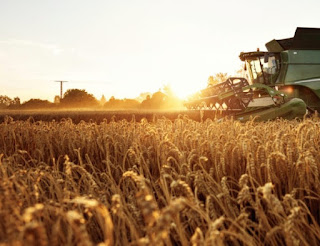
Harvesting wheat

Combines harvest the crop once the kernels have dried to 15 percent moisture or less. Harvesting of winter wheat starts in May and usually is completed by late July. Harvesting of spring wheat begins in late July and is completed by late August.

Wheat should be harvested without delay when it reaches maturity and begins to dry down to market moisture contents. A moisture meter is very useful to give a quick determination of crop condition. After wheat begins to dry in the field, repeated precipitation and drying begins to decrease quality and test weight.

Wheat is typically harvested in the 13 to 15 percent moisture content range. It also can be successfully harvested at higher moisture contents, provided it is dried quickly enough to prevent spoilage and/or sprouting.

Harvest begins with the cutting of a standing crop. Harvest may be accomplished in a single step by straight (direct) combining or in a series of steps that may include windrowing (swathing), combining, and drying the grain to a safe moisture level for storage. Straight combining is the preferred harvest method in most wheat production areas of the world.

Crops left standing un-harvested start to show diminishing quantitative and qualitative returns through shatter losses and attacks by insects, mould, birds and rodents. It is therefore important to complete harvesting as soon as possible.

Freshly harvested wheat grain should be dried to a moisture content of 14 percent or less within 48 hours to prevent sprouting and spoilage. High moisture wheat (>17%) can be dried with both high-speed and bin drying equipment.
Harvesting wheat
Saturday, November 7, 2020

Harvesting rice

Harvesting is the process of collecting the mature rice crop from the mature rice crop from the field. Harvesting system involved:
*Cutting: cutting the panicles and straw.
*Hauling: moving the cut crop to the threshing location.
*Threshing: separating the paddy grain from the rest of the cut crop.

The most important consideration in harvesting is the degree of maturity of the grain, which is determined by measuring moisture content. The optimum moisture content of the rice grain at harvest time is 21 to 24 percent.

The point of maturity is generally reached 28 to 32 days after flowering. If the crop is allowed to stand in the field after it reaches maturity, large losses occur in the both the field yield of the crop harvested and the percentage recovery of head rice after milling.

Early harvesting produces a higher quality milled rice. When grain is allowed to remain in the field after it is mature “sun checking” (cracking of the grain) occurs and many of the grains break during the grain is wetter and requires more drying before it can be stored. In addition, threshing early harvested paddy is more difficult.

The most common systems of paddy harvesting in Asia including:
1. Manual harvesting and handling
2. Manual harvesting followed by machine threshing
3. Machine harvesting with a reaper followed by machine threshing
4. Combine harvesting

Objectives of good harvesting:
*Maximize grain yield
*Minimize grain bosses
*Minimize quality deterioration

Rice milling is the process where in paddy is transformed into a form suitable for human consumption, therefore, it has to be done with utmost care to prevent breakage of the kernel and improve the recovery.
Harvesting rice

Sunday, August 12, 2018

Harvesting cranberries

Cranberries grow on vines in beds that have layers of sand, peat, gravel, and clay. People call those beds, bogs, as the fields are flooded with water at harvest time.

For harvesting cranberries, the bogs may be flooded with water to float berries, which can then be shaken off by machine and collected from the water. The workers then use hoses, rakes and nets to gather the berries floating on the surface of the water.

In other instances, the bogs are not flooded; the berries are stripped from the vines mechanically and collected on catching frame.

Dry harvest utilizes a picking machine that combs the berries off the vines, and may also prune the runners that come in touch with its multiple knives. Dry-picked berries are typically sold for the fresh market.

Water harvest is generally used for berries intended for processing (mainly juice). New Jersey harvests more than 95% of its cranberry crop by water harvesting. A small percentage of the crop is dry harvested for fresh market sale.
Harvesting cranberries

The Most Popular Posts