Showing posts with label wheat. Show all posts

Sunday, January 9, 2022

Harvesting wheat

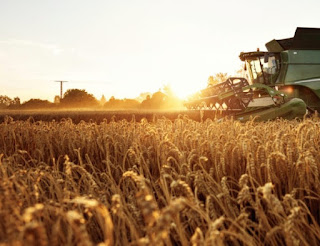
Combines harvest the crop once the kernels have dried to 15 percent moisture or less. Harvesting of winter wheat starts in May and usually is completed by late July. Harvesting of spring wheat begins in late July and is completed by late August.

Wheat should be harvested without delay when it reaches maturity and begins to dry down to market moisture contents. A moisture meter is very useful to give a quick determination of crop condition. After wheat begins to dry in the field, repeated precipitation and drying begins to decrease quality and test weight.

Wheat is typically harvested in the 13 to 15 percent moisture content range. It also can be successfully harvested at higher moisture contents, provided it is dried quickly enough to prevent spoilage and/or sprouting.

Harvest begins with the cutting of a standing crop. Harvest may be accomplished in a single step by straight (direct) combining or in a series of steps that may include windrowing (swathing), combining, and drying the grain to a safe moisture level for storage. Straight combining is the preferred harvest method in most wheat production areas of the world.

Crops left standing un-harvested start to show diminishing quantitative and qualitative returns through shatter losses and attacks by insects, mould, birds and rodents. It is therefore important to complete harvesting as soon as possible.

Freshly harvested wheat grain should be dried to a moisture content of 14 percent or less within 48 hours to prevent sprouting and spoilage. High moisture wheat (>17%) can be dried with both high-speed and bin drying equipment.
Harvesting wheat

Wednesday, September 26, 2018

Growing of winter wheat

There are two major types of wheat planted in the United States. They are winter wheat and spring wheat. The winter wheat plant resumes its growth in the spring.

The growth and development of the wheat plant is a complex process. During the life cycle of the plant, many of the growth stages overlap, and while one part of the plant may be developing another part may be dying.

The first signs of growth are tiny root hairs that stretch down into the soil while a small shoot pushes upward through the soil. The head of the wheat plant, which contains the kernels, develops at the tip of the stem.

The stem grows rapidly, pushing the head up and out of the top leaf sheath. As the plant grows, it uses the sun to make food in its leaves. The roots get food from the soil. Wheat grows many leaves and sends up 3-12 stems called tillers.

After the head emerges, flowering occurs and the kernels begin to develop. After the kernels have developed fully and filled, the leaves and stem lose their green color and the kernels quickly dry. Kernels within the head grow and turn golden brown before harvest. The seed moisture will decrease down to 13 to 14 %. This is the ripening stage and the seed may be harvested at the end.
Growing of winter wheat 

Extra note: 
A kernel is a wheat seed. There are about 50 kernels in a head of wheat and 15,000 to 17,000 kernels in a pound.

Saturday, December 5, 2015

Type of flour

An ingredient used in many foods, flour is a fine powder made from cereals or other starchy food sources. The flour properties of flour are influenced by the raw materials and by the milling process and the treatments applied after milling.

It is most commonly made from wheat, but also maize (aka corn), rye, barley and rice, amongst many other grasses and non-grain plants (including many Australian species of acacia).

The vast majority of today's flour consumption is wheat flour. Wheat varieties are typically known as "hard" or "strong" if they have high gluten content, and "soft" or "weak" if gluten content is low.

Hard flour, or "bread" flour, is high gluten-forming potential forming a very strong and elastic structure, which can hold the air and gases of yeast. It is typically made of hard red spring wheat kernels, with a high protein-to-starch ratio.

Soft flour is comparatively low in gluten and so results in a finer texture. Soft flour is usually divided into "cake" flour, which is the lowest in gluten, and "pastry" flour, which has slightly more gluten than cake flour.

All purpose flour combines the desirable qualities of both hard and soft wheat flour. It does not contain bran or germ, and is known as white wheat flour, or simply ’flour’.

Corn flour is very popular in the southern United States and in Mexico. Coarse whole-grain corn flour is usually called corn meal. Corn meal which has been leached with lye is called masa harina and is used to make tortillas and tamales in Mexican cooking.

Corn flour should never be confused with cornstarch, which is known as cornflour in British English.

Triticale flour: triticale is a hybrid of wheat and rye. Triticale fours have protein concentration of 10.7% - 16.3% averaging 13.4%. They generally have shorter dough development tines than do bread flours of wheat.

100% Rye flour is used to bake the traditional sourdough breads of Germany and Scandinavia. Most rye breads use a mix of rye and wheat flours because rye has a low gluten content. Pumpernickel bread is usually made exclusively of rye, and contains a mixture of rye flour and rye meal.

Rice flour is of great importance in Southeast Asian cuisine. Also edible rice paper can be made from it. Most rice flour is made from white rice, thus is essentially a pure starch, but whole-grain brown rice flour is commercially available.

Chestnut flour is popular in Corsica, the Périgord and Lunigiana. In Corsica, it is used to cook the local variety of polenta. In Italy, it is mainly used for desserts.

Chickpea flour (besan) is of great importance in Indian cuisine, and in Italy, where it is used for the Ligurian farinata.

Flour can also be made from soy beans, arrowroot, potatoes, taro, cattail and other non-grain foodstuffs.

Whole grain sorghum flour is used in the making of a bread, roti in India.

Tang flour is a kind of wheat flour used in Chinese cooking that is suitable for making outer layer of dumplings and buns. It is also called wheat starch. You can find it in any Chinese supermarket.
Type of flour
Tuesday, May 19, 2015

Planting of wheat

Wheat is the most widely consumed grain in North America. It makes excellent bread, pasta, sprouts and tasty whole or cracked kernels.

Wheat is a long day plant. Short days of high temperatures stimulate tillering and leaf formation but delay flowering of wheat plants.

Wheat prefers a nearly neutral soil (about Ph 6.4), and does best with a cool, moist growing season flowed by warm, dry weather for ripening.

Planting of winter wheat usually occurs in September or early October when the soil has sufficient moisture to germinate the seed. The germinated seed lies dormant during the winter. The onset of warm weather cause rapid new growth and seed heads develop within two months. Winter wheat is harvested in late spring to early summer.

Spring wheat is planted as early in the spring as temperatures allow. It tolerates drier conditions than winter wheat, but doesn’t yield as well. Spring wheat is harvested in late summer.
Planting of wheat

The Most Popular Posts